
Standardised Form for Easier Submission of Requests for Publication of Answers and Corrections
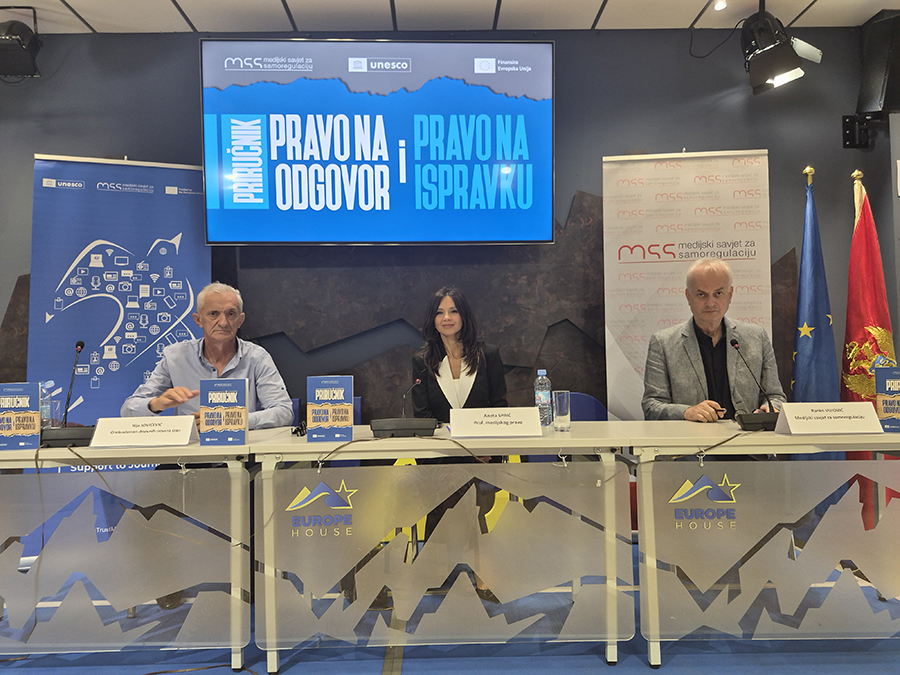
The Media Council for Self-Regulation (MSS) today presented the handbook "Right of Reply and Right of Correction" at the European House in Podgorica. It was prepared by the MSS in cooperation with professor of media law at the UCG, Aneta Spaić; ombudswoman of daily newspaper Vijesti and weekly Monitor, Paula Petričević; and the ombudsman of the daily newspaper Dan, Ilija Jovićević.
As the Media Council for Self-Regulation reminded, the right of reply and correction is an important legal instrument in the realisation of freedom of expression that ensures the presence of the "other side" in public communication, the legal guarantee of respect for the principle of Audi alteram partem (that the other side is also heard) and the protection of the reputation of a person, natural or legal one, to whom information relates that may harm some of his rights or interests. Also, the right of reply and correction enables the correction of incorrect information that is placed in the public space.
In order to help the citizens in exercising this right, but also to the editors to receive meaningful responses formulated in accordance with the legal provisions, at the end of the Handbook, the authors have offered a draft Form for submitting a request for the publication of reply and corrections, which can be modified and changed if necessary. The author's team recommends that the editorial office offer an electronic form available on the media's official website, to confirm receipt of the request and make a decision within a reasonable time, and to send feedback to the requester - whether it has decided to publish the response or to justify a possible rejection.
Ranko Vujović from the Media Council for Self-Regulation pointed out that this is just one of a series of manuals that they have prepared in the past few years.
"All these manuals dealt with individual segments from the Code of Journalists, some dealt with slightly broader topics and different media aspects, but basically they are all related to freedom of expression and the problems that freedom of expression has today. You are surely aware that probably never before in history have freedom of expression and democracy in the world been so threatened. Democracy is first of all tried to be undermined by undermining freedom of expression, which makes this handbook even more significant at this moment." stated Vujović.
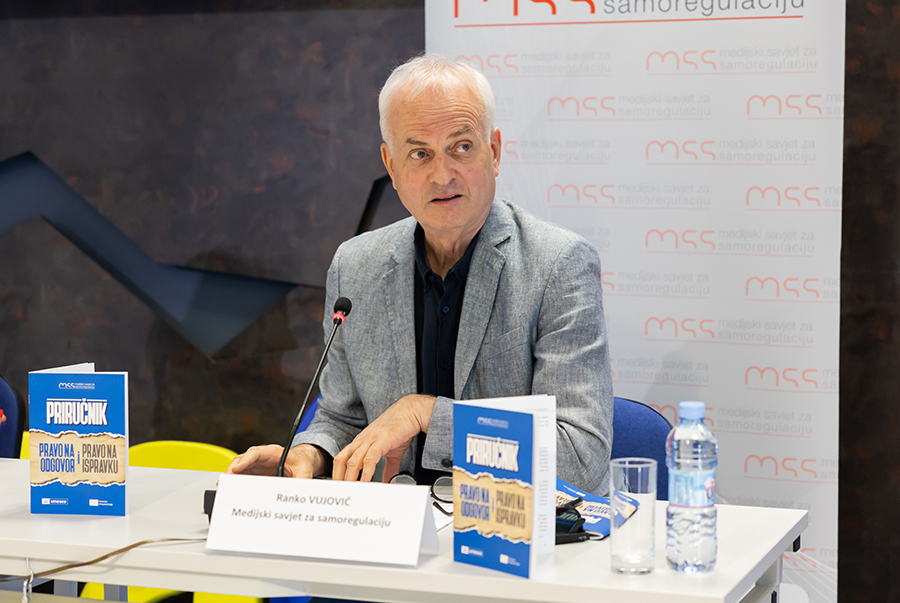
Vujović drew attention to the great importance of the right of reply and the right of correction.
"The right of reply and right of correction is one of the oldest rights when it comes to freedom of expression. For decades, international and national regulations have dealt with this right, which is extremely important because it regulates the rights of individuals in relation to the media. How important this right is it is evidenced by the fact that the right of response and correction is first of all regulated in our country by the constitution, as is the case in most countries in the world, and then it is specifically regulated by individual laws. Also, all codes in the world used by journalist communities have a defined right to response and this right was explained in detail in the Media Act of Montenegro," Vujović added.
On this occasion, Vujović reviewed a number of significant conventions and laws that regulate the right to answer and the right to correction. He recalled that in 1953 the United Nations even adopted the Convention on the International Right to Correction, and in 1974 the Council of Europe adopted the Resolution on the position of the individual in relation to the press, which was a pioneering document by which the Council of Europe systematically introduced the right of reply for the first time. He also drew attention to the resolution of the Parliamentary Assembly of the Council of Europe on ethics in journalism from 1993, the Recommendation of the Council of Europe on the right of reply in the new media environment from 2004 and the directive of the European Union on audio-visual media services from 2010, which was revised in 2018.
Despite this legal and international recognition of the importance of the right to reply and the right to correction, failures occur in the application of this right in practice.
"For the last 20 years, it has been quite a big problem for the media to respect the right to answer and correction. In the Media Act, you have a whole series of situations when the media is not obliged to publish an answer or correction. And it has been known to be abused very often, because our media are very reluctant to publish answers and corrections. There have been situations where you send a response, and the media publishes it after a few days on the fifth or sixth page, in some corner, at the bottom of the page where no one will see it. And that has been the case for years regular practice. And people were quite angry and resentful of the media for such treatment. Especially if someone seriously accuses or slanders you in that media, that you do not have an equal possibility for your answer or your position can be heard and published. We, working a little more intensively in previous years, persistently sent complaints to the media and succeeded to some extent in forcing them to respect the rights of individuals and their readers. The other side cannot hide, especially if it is important information or if it is a person's reputation. Because in our country, the media used to slander people very often, sometimes with a reason, and sometimes without a reason and because of some other interests, and then it was very difficult for those people to wash the stain off themselves and to prove something, because that very right to reply and correction did not work as it should," said Vujović.
Professor of media law at the Law Faculty, University of Montenegro, Aneta Spaić, spoke in more detail about the legislative framework in Montenegro and the countries of the former Yugoslavia.
"The national framework in Montenegro regarding these two instruments has been an adequate legislative response since 1974, when the constitution first inaugurated the concept of the right of correction. It is no wonder that all regional states, as former members of the Socialist Federal Republic of Yugoslavia, have the right of reply and the right of correction in their legislation, and they are regulated very similarly, very closely, and what we can claim is that the minimum European standard is ensured in all these national systems. Montenegrin Constitution refers through four articles to freedom of expression, one refers precisely to the right of reply and correction, and in the constitutional provision it is said that the right of correction of any untrue, inaccurate and wrongly transmitted information that harms one's interest and for which one has the right to compensation is guaranteed. This constitutional provision, which was introduced into our legislation for the first time in 1974, was repeated in the 1992 Constitution, but that constitution for the first time separates the right of correction and the right of reply, so instead of the general definition of the right of correction from 1974, the 1992 constitution actually separates these two institutes," said Spaić.
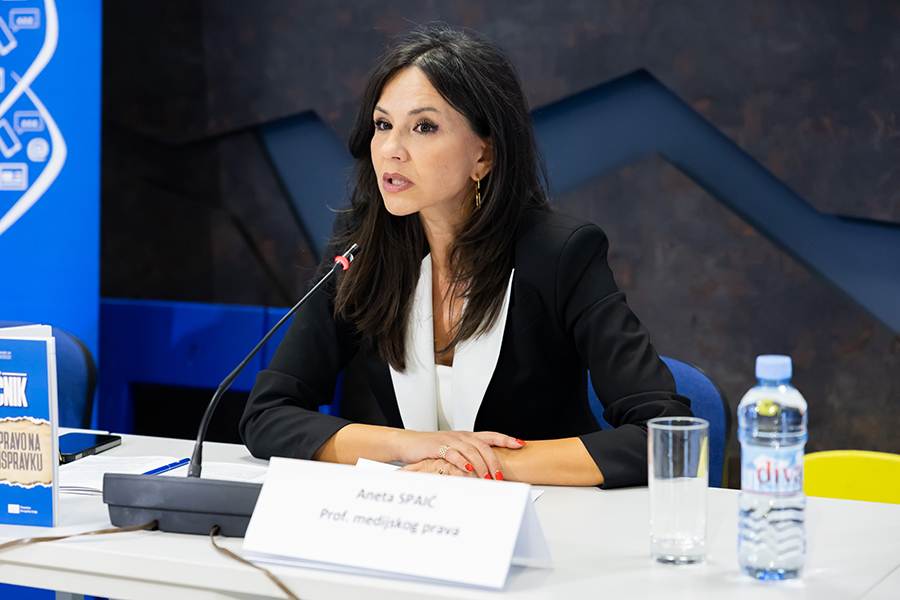
Spaić reminded how the Law on Media from 2024 defines the application of those rights.
"The editor, or the media that published the original content, has the obligation to publish the response of the person whose rights and interests were violated by the original text in the same place, to the same extent, without insults, personal attacks and slander, and referring to the factual allegations. In relation to such a determination, i.e. the right of reply and correction, we have prescribed exceptions when the editor, i.e. the media can refuse it. And they are enumerated, nine of them, and refer to the following:
- if the person who submitted the answer is not the person whose right or interest has not been harmed by the original text, that is, by the harmful information from the original text;
- that the answer does not refer to the published media content,
- that a correction based on a final judgment has already been published earlier,
- the reply or correction concerning the same media content has already been published, or if a reaction with the same content as the submitted reply or correction has already been published in the same media outlet, in another media content, at the request of the same person;
- that the text was not composed in a proportional volume, i.e. a similar volume as the original text,
- that it contains statements that could fall under misdemeanour, criminal and other liability
- that the person submitting the request for publication of a reply or correction had not provided their full name, address or identity card number, or in the case of a legal persons, its name and registered office;
- that it was not delivered in the language it is in first citation submitted.
- that the correction was requested about the accurately reported public event.
When these reasons do not exist, the editor is obliged to publish the response of the person whose right or interest has been violated in the first issue, or at the latest in the second issue. In relation to this question, when the editors refuse to publish the answer, of course the law signs the so-called an urgent procedure in which, by addressing the court, the person who was injured by the original content can apply," explained the professor.
Professor Spaić more clearly defined the difference between the right of reply and the right of correction.
"Although both institutes point out that it is a question of the right to refute, correct, supplement untrue, incomplete and inaccurate information, the right of reply is the right of the person whose interest has been violated to use his arguments and allegations to try to respond with different facts than those presented in the first media content. In contrast to this right of reply - the right of correction also refutes, corrects, supplements inaccurate and incorrectly stated facts. But it does so on the basis of a credible document and some final judgment. The nuance is that in the right of reply, I present my arguments and facts in relation to the facts presented by you. If in your original text you slandered me, used unreasonable personal attacks, if you did not even use arguments, it is the right of the editors to reject my answer if it contains offensive, slanderous and other content and if there are no factual statements. Therefore, the answer must always be a factual statement, and never a value statement. Even in that part where it is valuable, it can be excluded and corrected by the editorial staff, that is, by the media. The correction has one nuance, and it would be most accurate to say that the correction is the right to an answer with concrete evidence. If you bring me a decision that you have paid a certain fine, that you have received a final verdict in which you are acquitted of forging a document, confiscating someone else's material benefit or anything that is the subject of the original text, and you prove it with an indisputable and credible document, that is, a document, that is already the right of correction. Therefore, the right of correction, if we are going to express ourselves quite clearly in layman's terms, would be the right to an answer with the submission of certain evidence," explained Spaić.
While working on the development of this manual, the author's team conducted a series of interviews with the leading editors of the Montenegrin media in order to see how they view this right and how much it is represented in their media. More details were presented by daily newspaper "Dan", ombudsman Ilija Jovićević.
"The editors were almost identical when it comes to what the answer and correction must contain. Well, they say, the answer and correction must have data, arguments related to the allegations in the media content, name, surname, address and identity card number for a natural person, name and registered office of a legal entity. The answer and correction must be clearly titled as a correction or answer, contain information about the submitter, specify precisely which text and claims they refer to. The essence must be refuting or supplementing the facts presented on civilized and argumentative way that allows the reader to get a complete picture. The answer and correction must clearly and concretely indicate incorrect and incomplete statements from the published content, be based on facts, and be related to the specific text to which it refers. In order to exercise the right to correction more easily and quickly, we asked whether a standardized form for submitting answers and corrections would improve the existing practice. What must be commendable is that all the editors agree with such a proposal. They believe that a standardized form would improve the existing practice, and would be especially significant for insufficiently informed parties. They believe that a standardized form could be useful even for citizens who are not legally informed, because it would reduce the number of formally incorrect requests," said the ombudsman of the daily newspaper "Dan", Ilija Jovićević.

In cooperation with the ombudswoman of daily Vijesti and weekly Monitor, Paula Petričević, the standard form for submitting requests for reply or correction, has been created and it is at the end of this presented handbook. This form standardizes form for citizens to easily submit requests for the publication of answers and corrections.
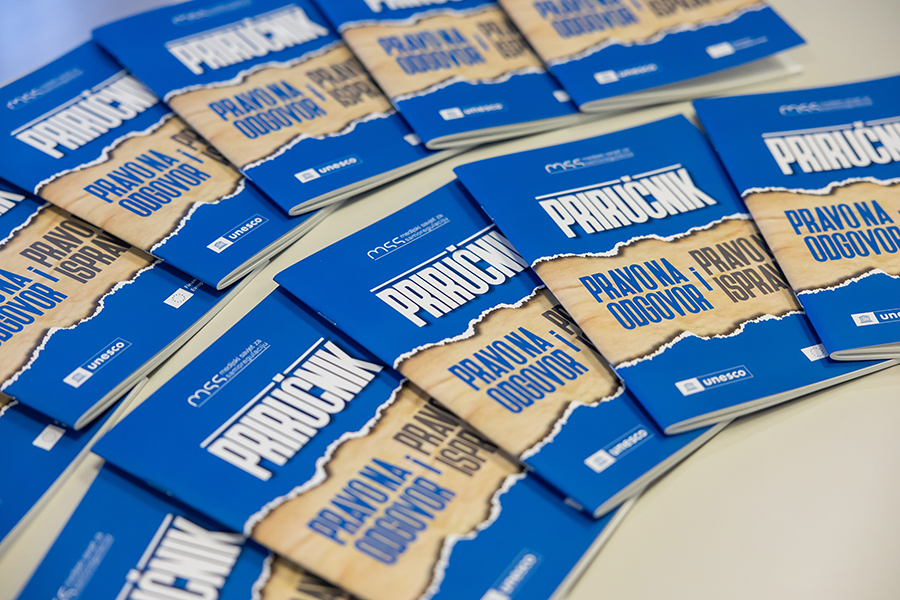
The handbook "Right of reply and right of correction" is part of the UNESCO project, funded by the European Union, "Building trust in the media in Southeast Europe: Support to Journalism as a Public Good", which is implemented by self-regulatory bodies from Albania, Bosnia and Herzegovina, Montenegro, Kosovo*, North Macedonia, Serbia and Turkey.
Link for download of the handbook “Right of Reply and Right of Correction”